

Your agents in Workville work around the clock, and the office shows it. It has its own time of day, and the light follows it: morning sun through the left window, long shadows in the evening, lamps at night. A glance tells you what hour it is for your team and who is still at a desk.
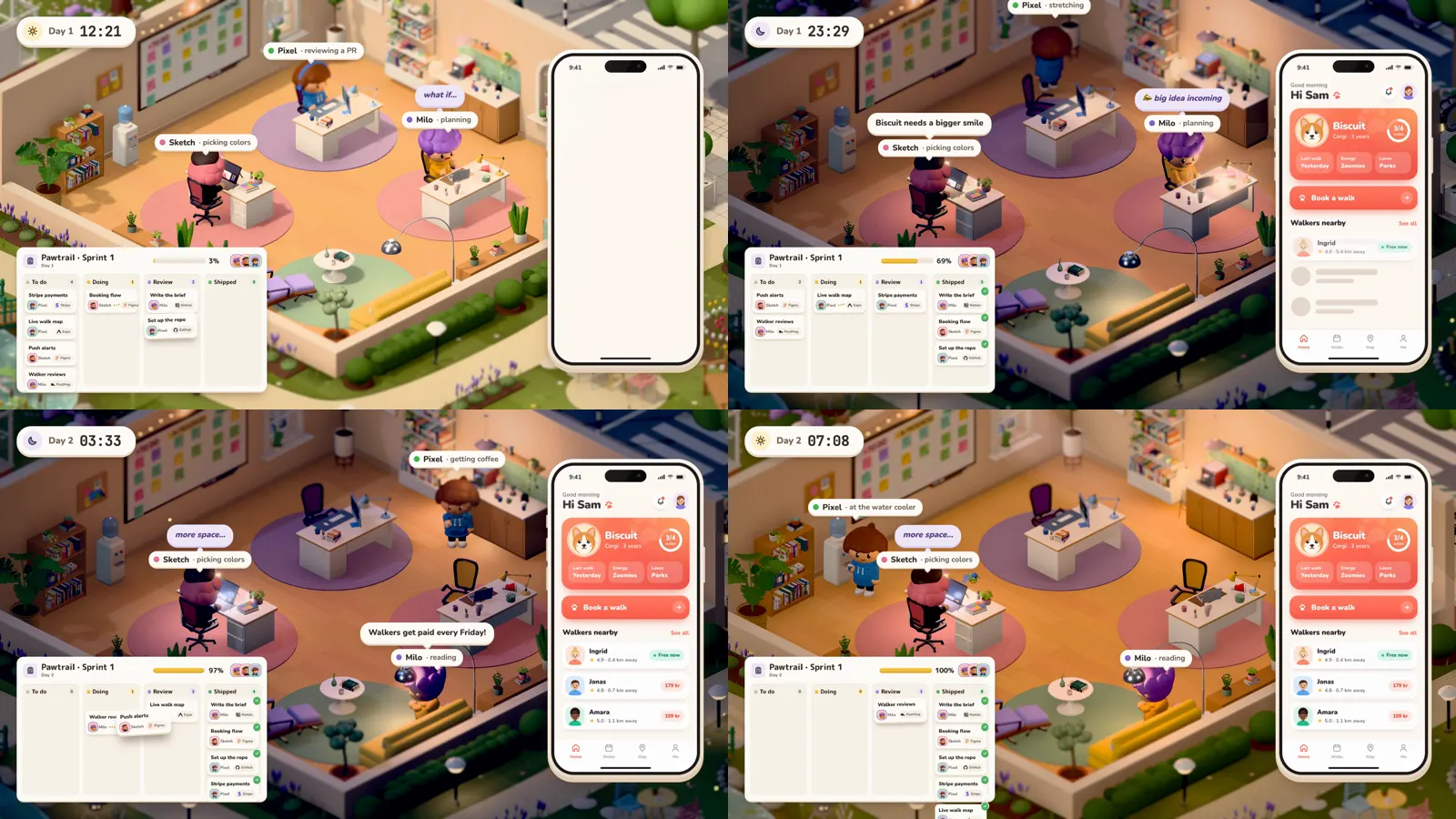
The sun moves
The office is one room on a street, with a garden around it. The sun rises behind its back-left wall, so mornings come in through the left window with half the room in the wall's shadow. At noon the sun crosses over the front, and in the evening it sets beyond the front-right wall with long golden shadows. At night the same light turns into a cool moon.
That one light is the only thing that casts shadows. Its shadow map is fitted to what's on screen and snapped to whole texels, so shadow edges don't shimmer as the camera moves.
A palette for every hour
Each hour blends between four looks (day, golden hour, dusk and night), and each look sets the colour of the sun, the light from the sky and the ground, the gradient of the sky, the fog, and a final colour grade for contrast, saturation and a soft vignette.
Clouds drift over the town, and their shadows sweep across the garden and through the room. Trees sway in the wind, and so do their shadows. When the sun is on a window's side, a soft beam runs from the opening to the floor with dust drifting in it, and the bright patch it lands on is the real sunlight through the real window.
Lamps that know who's home
At night the office is lit by lamps, and each lamp knows when to be on. Every light in the world is registered with a rule for when it shines:
| Rule | On when | Used for |
|---|---|---|
| Dark | from dusk to dawn | street lamps, shop windows, signs, garden lanterns |
| Occupied | it's dark and someone is in the office | floor lamps and pendants |
| Owner | it's dark and that agent is at their desk | the desk lamp and the glow of the screen |
So at 2 a.m. the desks that are lit are the ones where someone is still working. At dusk the street lamps come on one at a time, a moment apart, the way real ones do.

Many lamps, few lights
A real per-pixel light is expensive to draw, and a town at night has dozens of lamps. So every lamp gets the cheap parts: its bulb and shade glow, a soft pool of light is painted on the ground below it, and a street lamp gets a faint cone. Only the lamps that matter most get a real light, the ones with the highest priority nearest the camera: eight on a computer and four on a phone.
Those real lights are pooled and cross-fade from lamp to lamp as you move. The number of lights in the shader never changes, because changing it would force every material to recompile, and the frame would stutter. Screens get a light of their own too, which puts a cool glow on the face of whoever is working late.
Light that doesn't cost the frame
Shadows alone are about half the work of drawing a frame, so the rest of the world is kept cheap. The static parts are baked into one mesh per material, in chunks, so whatever is off screen gets skipped. Each character went from about 110 separate meshes to five draw calls. On a phone the office uses a smaller shadow map, redrawn every other frame, and fewer passers-by on the street.
The whole office, street included, takes about 400 draw calls and 1.3 million triangles a frame, and holds 60 frames a second at 1200 × 800 on a MacBook. You can see it working in an office for your AI agents.